ADHD in Adults & The General Practitioner
A comprehensive clinical guide on identifying, assessing, and managing adult ADHD in general practice, now available in English.
ADHD in Adults & The General Practitioner: Bridging the Gap in Primary Care
Identifying, Diagnostic Assessment, and Maintenance Treatment
In the Netherlands and across Europe, the General Practitioner (huisarts) plays a pivotal role in the life of an adult with ADHD. First, it is the GP who must recognize the underlying signs of neurodivergence and provide a referral for diagnostic assessment. Later, once specialized mental healthcare (GGZ) has stabilized treatment, the patient typically returns to the GP for long-term maintenance and monitoring.
Yet for many GPs—and for expats trying to navigate the Dutch healthcare system—adult ADHD remains somewhat unfamiliar territory.
To bridge this gap, Prof. Sandra Kooij (psychiatrist at PsyQ and the Dutch Expertise Center ADHD in Adults in The Hague), in collaboration with general practitioners at 'de Doc', authored a practical clinical manual drawing on over 30 years of clinical experience. I recently had the pleasure of helping Prof. Sandra Kooij translate this essential October 2026 guide from Dutch into English so that international practitioners, coaches, and English-speaking patients can benefit from it.
Download the Complete English Manual (PDF)
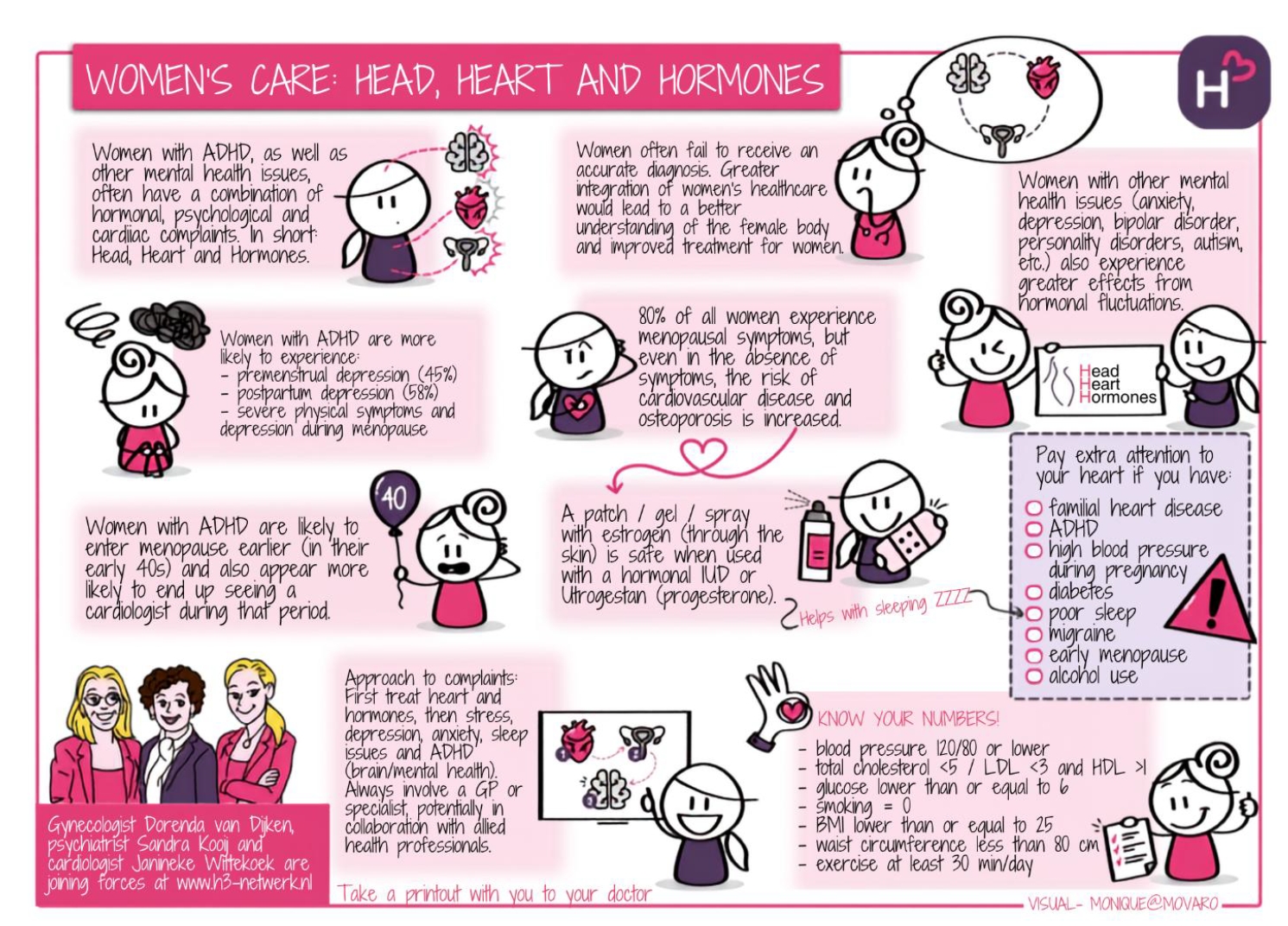
Access the full 24-page booklet, including the 4-question Ultra-Short Screening Questionnaire, the GP Maintenance Checklist, the Adult Medication Overview, and the H3-Network infographic.
1. Recognizing Adult ADHD in General Practice
ADHD occurs in 3–5% of the adult population up to advanced age. In daily life, adults rarely walk into a clinic simply asking about attention deficits; instead, they present with complaints such as experiencing a "full head," chronic fatigue, recurrent burnout, inability to sleep, difficulty relaxing, anger outbursts, binge eating, or anxiety and depression.
Often, the realization begins when one of their children is diagnosed: "I was like that too when I was young, and I actually still am."
Because untreated ADHD carries significant mental and physical health risks—including higher rates of sleep disorders, cardiovascular issues, obesity, migraines, and accidents—early recognition is vital. The manual introduces the Ultra-short Questionnaire for ADHD in Adults, which allows GPs to screen for core symptoms and lifelong chronicity in just 4 questions:
- Do you usually feel restless? (e.g., rushed, trouble sitting still, fidgeting, exercising excessively, or being constantly in motion)
- Do you usually tend to act first and think later? (e.g., blurting things out, spending too much money, or being impatient)
- Do you usually have concentration problems? (e.g., easily distracted, not finishing things, quickly bored, forgetful, or chaotic)
- If yes to one or more: Have you always had this? (as long as you can remember, or for most of your life)
When ADHD is suspected, the manual highlights the newly updated DIVA-5-R (Revised in 2026) diagnostic interview, specifically refined to improve recognition in women and older adults who are frequently underdiagnosed or diagnosed far too late.
2. Holistic Treatment & Medication Maintenance
Effective adult ADHD care consists of four pillars: psycho-education, medication, coaching, and cognitive therapy. When a patient transitions back to the GP for maintenance, the manual outlines a structured protocol featuring biannual check-ups (evaluating blood pressure, pulse, weight, adherence, and life stressors) alongside a practical 19-item patient self-checklist.
Key clinical insights from the manual include:
- Why Long-Acting Stimulants Are Preferred: Long-acting preparations reduce "rebound" phenomena (the temporary spike in symptoms as short-acting medication wears off), improve safety in traffic, and require fewer daily doses—meaning fewer forgotten pills.
- Side Effects vs. Rebound: True side effects typically appear around 1.5 hours after intake, whereas rebound occurs as the medication wears off.
- Tailoring to Real Life: Most adults also need focus and emotional regulation in the evening at home, not just during office hours. Combining long- and short-acting stimulants or adjusting timing helps prevent evening crashes.
3. Sleep and the ADHD Biological Clock
Up to 80% of adults with ADHD struggle with sleep onset and maintenance, most commonly due to a delayed sleep phase syndrome caused by late natural melatonin production. Poor sleep directly worsens executive dysfunction and mood.
Alongside sleep hygiene and avoiding blue light after 21:30, the guide explains how low-dose melatonin (0.5–1 mg taken at a fixed time like 22:00) or long-acting melatonin (Circadin 2 mg for those waking up around 03:00) can shift the biological clock earlier. Combining this with morning light therapy (10,000 lux light boxes or light therapy glasses for 30 minutes between 07:00–07:30) provides a powerful reset for both sleep rhythm and winter depression.
4. Women's Health: Head, Heart, and Hormones (H3)
One of the most important sections of the manual addresses how hormonal fluctuations impact women with ADHD. Because estrogen directly supports dopamine synthesis and inhibits its breakdown in the brain, any drop in estrogen hits an already dysregulated ADHD dopamine system twice as hard.
- Higher Vulnerability: Women with ADHD experience premenstrual depression (45%), postnatal depression (58%), and severe perimenopausal symptoms 2 to 3 times more frequently.
- Earlier Perimenopause: Recent population studies show that perimenopause in women with ADHD may begin 5 to 10 years earlier—sometimes as early as age 35—long before anyone suspects it.
- Targeted Adjustments: Continuous birth control pills (with bio-identical hormones), low-dose continuous SSRIs, timely Hormone Replacement Therapy (HRT), and a premenstrual stimulant dose increase of 30–50% can make a life-changing difference.
- The H3 Order of Treatment: Initiated by psychiatrist Sandra Kooij, cardiologist Janneke Wittekoek, and gynecologist Dorenda van Dijken, the Head Heart Hormones (H3) Network (www.h3-netwerk.nl) recommends treating Heart (cardiovascular complaints) and Hormones first, followed by stress, sleep, anxiety/depression, and Head (ADHD).
Take the Guide to Your Next Appointment
Important: This booklet is designed as a clinical reference for healthcare providers and should not be used as a substitute for direct medical advice. However, if you are an expat or adult in the Netherlands preparing for a conversation with your huisarts about diagnosis, medication adjustments, sleep, or hormonal shifts, printing out this guide (or sharing the H3 visual on page 24) can give you and your doctor a clear, evidence-based starting point.
Read & Download "ADHD in Adults and the GP" (PDF)