Is Your ADHD Getting Worse — Or Is Something Biological Going On?
You know the feeling. You're doing everything you're supposed to do, and still — the fog won't lift. The paralysis is back. Your strategies aren't working the way they used to. And the easiest explanation is that your ADHD is just... harder right now.
Is Your ADHD Getting Worse — Or Is Something Biological Going On?
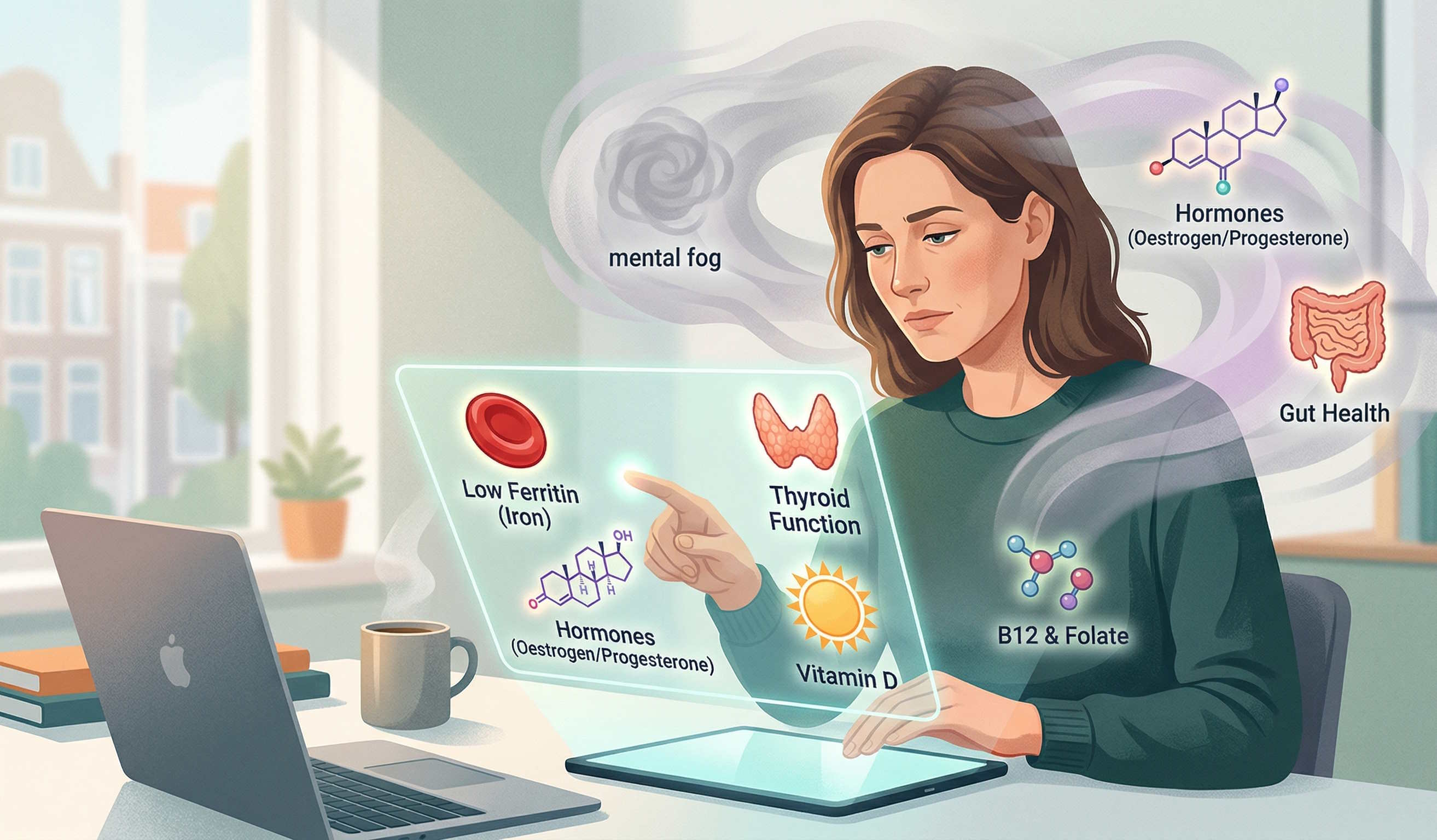
Often your intuition is right, and your ADHD is indeed getting worse but sometimes there's a biological layer underneath that nobody has looked at yet. Several common and testable conditions produce symptoms that are almost indistinguishable from ADHD — brain fog, difficulty initiating, mental exhaustion, emotional overwhelm, motivation crashes.
When one of these is present alongside ADHD, it doesn't announce itself separately. It just makes everything feel worse. Here's what's worth knowing about.
🩸 Low ferritin (stored iron)
Iron plays a direct role in dopamine production — the neurotransmitter at the core of ADHD. Low ferritin doesn't always show up as anaemia, but it can quietly affect focus, motivation, and cognitive stamina. Standard blood panels often miss it.
⏩ Worth checking if: your mental fatigue feels disproportionate to what you've actually done.
🦋 Thyroid function
An underperforming thyroid slows everything down — thinking, processing, energy, mood. The cognitive symptoms closely mirror ADHD. A basic TSH test is a reasonable start, though free T4 can add useful context.
⏩ Worth checking if: fatigue comes with feeling cold, sluggish, or mentally heavy even after a ‘good night’s sleep’.
🧬 B12 and folate
Both are essential for producing the brain chemicals involved in mood, focus, and mental energy. Deficiency causes a cognitive flatness that's easy to mistake for worsening ADHD. It is more common than most people expect — particularly if you're eating a plant-based diet, over 40, or on certain medications.
⏩ Worth checking if: your thinking has become slower or flatter and your diet has changed recently.
🦠 Gut health
The gut and brain are in constant communication. A disrupted gut can impair serotonin production and reduce absorption of the very nutrients your brain depends on — B12, iron, folate, magnesium. The research specifically on gut health and ADHD is still early, but the link to brain fog and cognitive fatigue is well-established.
⏩ Worth checking if: digestive symptoms and cognitive symptoms tend to show up together.
☀️ Vitamin D
Low vitamin D is associated with fatigue, low mood, and poor concentration. In the Netherlands, deficiency is common for much of the year regardless of diet.
⏩ Worth checking if: symptoms are noticeably worse in autumn and winter.
⚖️ Hormones (for women over 35)
Oestrogen directly affects dopamine and serotonin — the systems involved in ADHD. As it fluctuates during perimenopause, strategies that previously worked can suddenly feel inadequate. Progesterone and SHBG add further context.
⏩ Worth checking if: your cognitive function and emotional regulation have shifted noticeably in the past year or two.
🩺 Other hormonal conditions: PCOS and beyond
Conditions like PCOS (polycystic ovary syndrome) involve hormonal imbalances — elevated androgens, irregular oestrogen and progesterone patterns, and often insulin resistance — that can significantly affect energy, mood, and mental clarity.
Insulin resistance in particular impairs the brain's ability to use glucose efficiently, which can show up as brain fog, difficulty concentrating, and energy crashes that look a lot like ADHD. There is also emerging research suggesting women with PCOS are diagnosed with ADHD at higher rates than the general population, though the reasons for this aren't yet fully understood.
Other conditions worth being aware of include adrenal dysfunction and elevated cortisol, which can disrupt sleep, worsen anxiety, and affect cognitive function over time.
⏩ Worth checking if: you have irregular cycles, unexplained weight changes, acne, or energy crashes — particularly after meals.
## So what do you do with this?
None of this requires certainty — just curiosity. These are accessible, testable factors. Finding and addressing even one can make a meaningful difference to your energy, focus, and mental clarity. Not instead of your ADHD support, but alongside it.
If you're doing everything right and still struggling more than you feel you should be, it may be worth asking whether something biological hasn't yet been explored.
When you're exhausted and don't know where to start, I take the time to sit with your full picture — your symptoms, your history, everything you've already tried. Together we work out what's worth exploring, how to talk to your GP about it, and what nutrition and lifestyle support can do in parallel.